SVPP Newsletter Issue 27
SVPP Newsletter Issue 27
Welcome to the Wiltshire SVPP’s e-newsletter bringing you the latest news and updates from the SVPP, including the Wiltshire Community Safety Partnership (CSP).
News in Brief
Working Together 2026
On 18th March 2026 the Department for Education published an update to Working Together to Safeguard Children along with the Children’s social care national framework. You can find the updated guidance, and a summary of the key changes at Working together to safeguard children - GOV.UK.
We will be updating our website to reference the latest version of the guidance and ensure any changes are reflected. The new guidance will be considered by our sub-groups and executive, and we will advise you of any further changes we make. This is a smaller update than in 2023, but it aligns this statutory guidance with other government guidance and initiatives, such as the Families First Partnership Programme, which also saw a new programme guide published in March.
We will also be amending our training materials and sub-group terms of reference to reflect the new publication.
Child Safeguarding Practice Review Panel Report - protecting all vulnerable babies better
The Child Safeguarding Practice Review Panel published a new report Protecting all vulnerable babies better – a national review into the broader safeguarding issues raised by the death of baby Victoria Martin. You can read the report at Protecting all vulnerable babies better.
The panel also held a webinar exploring the report which can be viewed via there YouTube channel - WEBINAR: Protecting all vulnerable babies better
In Wiltshire, our partnership groups are considering the recommendations that relate to safeguarding partnerships and considering what we need to do in Wiltshire to further strengthen our protection of vulnerable babies.
We have also recently updated our Sudden Unexpected Death in Infancy (SUDI) policy, which can be found in the policies section of our website here.
Child Safeguarding Practice Review Panel annual report for 24/25
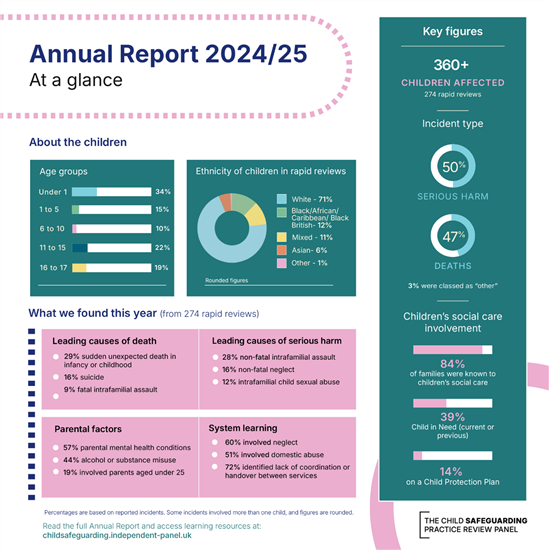
The Child Safeguarding Practice Review Panel has published its annual report for 24/25 (see summary infographic below) and a new website which can be found at Child Safeguarding Practice Review Panel | Your hub for practical safeguarding learning
This website acts as a hub for learning by topics, as well as providing information about the panel and its work. It will develop in due course, but is envisaged to be used to support learning across the system.
Key learning
Please see a link to the Child Safeguarding Practice Review Panel Newsletter - April 2026.
In this issue you can read the Annual Report 2024/25, about the new online safeguarding learning hub and other useful resources.

Safeguarding Adult Leaflet
The SVPP has worked with partners and the Pioneers and Innovators Group to produce a leaflet and poster for professionals to set out how and when to refer to the MASH and what happens next.
To help raise awareness and understanding of safeguarding adults, the following resources have been produced by the partnership here. Please feel free to share within your organisations.
Raising Awareness of Economic Abuse: Finance Fortnight (11th to 22nd May)
Economic abuse is often missed when domestic abuse is talked about, but it’s an issue that affects many.
‘Finance Fortnight’ is a two-week social media campaign led by FearFree, SWA and the You Trust. The campaign aims to raise awareness of what economic abuse is and the different forms it can take, including lesser‑known examples such as misuse of subscription services and loyalty schemes. It will also include signposting to advice and support.
Follow and support the campaign via:
- @fearfreecharity
- @theyoutrust
- @societywithoutabuse
In addition, Wiltshire SVPP have developed an
economic abuse factsheets for the public and professionals. Find them on their website (under adult safeguarding): Wiltshire Safeguarding Vulnerable People Partnership (SVPP) - Policies and guidance
Children’s Practitioner Forum 9th June, 9am – 10.30am
The Children’s Practitioner Forum provides an opportunity for practitioners from all agencies to come together and reflect on our safeguarding system, with any concerns raised being fed into relevant partnership sub-groups, as well as providing an opportunity to network and learn about the work of other agencies. It also provides an opportunity for the partnership to test ideas and gain views directly from practitioners.
We will also be using the refreshed forum as an opportunity to explore the use of the Graded Care Profile 2 as a key tool for practice, sharing any insights from the NSPCC and providing an opportunity for practitioners to explore with others the use of the tool.
As we are refreshing the forum, we are also refreshing our invite list, and would ask that colleagues please register at SVPP Children's Practitioner Forum Registration – Fill in form

NEW- Local Drug Information System (LDIS) Online Reporting Platform
Public Health have announced that the Local Drug Information System (LDIS) online reporting platform has gone live on 1 April 2026.
An LDIS report should be submitted when one of more of the below criteria is, or is suspected to be, met:
- Substances causing acute medical, social, or emotional harm
- New or novel substances causing harm
- Substances that are anecdotally reported to have uncommon side effects – not normally associated with the substance
- Substances with a spike in purity or strength of their active ingredient
- Contaminated and/or adulterated substances
- Substances that are branded to mislead the user of the ingredients
- Emerging methods of mixing or ingesting substances that could be particularly hazardous
This new system has been developed to streamline how PH report and respond to local drug-related intelligence. Moving to an online platform will make reporting faster, more consistent, and easier for all partners involved.
What this means for you:
- All LDIS submissions should be made using the new online form, which will go live on our drug and alcohol homepages on April 1st:
- The form will now automatically be directed to out of hours colleagues if submitted outside normal working hours, but please ensure you follow the instructions at the end of the form, which will provide guidance on where telephone contact is necessary.
- The system has been designed to be simple and intuitive, but this video will give you more information on the LDIS process.
- Please forward this email with your wider teams and networks, to keep everyone informed on how to tackle drug induced harms within our communities
Thank you to everyone who has contributed to the development and testing of the system. Your feedback has been invaluable in shaping a more effective and user‑friendly reporting process.
Domestic Abuse in Later Life: A Free Event for Professionals Working in Wiltshire
- Do you work with adults aged 60+ in Wiltshire?
- Are you interested in learning more about domestic abuse and how to support those affected?
Wiltshire Office of the Police and Crime Commissioner, Wiltshire Council and the Wiltshire Domestic Abuse Partnership invite local practitioners to a free, full‑day event designed to build knowledge, skills, and confidence in recognising and responding to domestic abuse in later life. This interactive day will feature a blend of expert talks, educational workshops, and facilitated discussions. Full details are available on the Eventbrite page.
Monday 15th June 2026- 9am-4pm at Neeld Hall, Chippenham (pay & display parking and public transport links nearby)
Reserve your free ticket through the Eventbrite page, and let us know any dietary and accessibility requirements when booking. Ticket booking closes on 31st May.
Prevent: Notice, Check, Share: Guidance for Professionals
The “Notice, Check, Share” procedure is the Home Office endorsed process for flagging concerns that an individual may be vulnerable to radicalisation, supporting the Prevent duty to stop terrorism. It involves recognising concerning behaviour, validating concerns with a manager / safeguarding lead, and referring to police if needed.
Notice: Spot the Signs
Those who work in frontline support roles will often be the first to notice if someone displays concerning behaviour, like the signs of radicalisation outlined below. If you notice behaviours that cause you concern, then you may want to consider whether the person is susceptible to radicalisation.
There could be many different reasons for these behaviours, not just radicalisation. It’s important to understand the context, and why these changes are happening, before jumping to any conclusions.
Radicalisation can happen both in person and online.
Everyone is different, and there is no checklist that can tell us if someone is being radicalised or becoming involved in terrorism. But these signs may mean someone is being radicalised:
- accessing extremist content online or downloading propaganda material
- justifying the use of violence to solve societal issues
- altering their style of dress or appearance to accord with an extremist group
- being unwilling to engage with people who they see as different
- using certain symbols associated with terrorist organisations
Check: Validate Concerns
You may wish to discuss your concern organisationally, with the person responsible for safeguarding, such as the designated safeguarding lead. Checking before sharing a concern is a way of making sure you have gathered as much relevant information as possible before making your referral.
Share: Act Promptly
Once you have gathered the relevant information, it is essential to share a concern and make a referral to the police using the National Referral Form. In some cases, you may do this directly. Sometimes, where appropriate, the organisational safeguarding lead or equivalent, or the local authority may do this on your behalf.
Professionals can complete the Prevent duty training to find out more.

Important: If there is an immediate threat to life or safety, dial 999 or the Anti-Terrorist Hotline on 0800 789 321.
Referring into Prevent, what you need to know
Referrals for Prevent are currently submitted to Counter Terrorism Policing at PreventReferrals@wiltshire.police.uk for them to complete their checks. A copy of the referral form can be found on the SVPP website here.
CT Policing colleagues will screen and assess for genuine susceptibility. If there are any other non-CT related safeguarding concerns such as domestic abuse, neglect or mental health concerns, professionals may also wish to make a referral to the;
- Integrated Front Door Service for concerns for children requiring non-urgent action
Integratedfrontdoor@wiltshire.gov.uk for urgent action for a child call 0300 456108.
- Advice and Contact for concerns for adults safeguarding: adviceandcontact@wiltshire.gov.uk
Putting in a referral for non-CT concerns will allow Wiltshire social work professionals to assess these specific needs and put support in place for the vulnerable adult or child.
Counter Terrorism Police will still be doing their safeguarding checks and balances alongside this to make sure CT concerns are still being dealt with appropriately.
Adoption West
Upcoming campaigns and dates for the diary

Carers Week is an annual campaign to raise awareness of caring, highlight the challenges unpaid carers face and recognise the contribution they make to families and communities throughout the UK. It also helps people who don't think of themselves as having caring responsibilities to identify as carers and access much-needed support.
The theme for Carers Week 8-14 June 2026 is Building Carer Friendly Communities. This will highlight the impact carer friendly communities can have in making a real and lasting difference to the lives of carers everywhere. For more information please visit their website here.

World Elder Abuse Awareness Day is observed annually on June 15 the theme is: Beyond Awareness: Making Elder Abuse Prevention Work.
As populations age, more people with disabilities are growing older, and many older persons develop disabilities later in life. This overlap calls for closer coordination between efforts on ageing and disability, especially in areas such as protection, care, and community-based support—all of which are essential to addressing elder abuse.
Elder abuse remains widely under-recognized and under-reported. It can take many forms, including physical, psychological, and financial abuse, as well as neglect. It often occurs in situations where individuals lack visibility, support, or access to services. Addressing this issue requires more than raising awareness. It calls for stronger systems that can prevent abuse and respond effectively when it happens, while respecting the dignity, independence, and rights of older persons. For more information, visit the United Nation website.

Ygam provides free Gaming and Gambling Harm Prevention Training specifically for teachers, youth workers, and youth-facing professionals. Our sessions help you understand current trends, spot signs of harm, and deliver effective preventative education to the young people you support.
Did you know?
- More young people are gambling than vaping (30% vs 13%).
- 60% have spent their own money on virtual items such as loot boxes.
- 31% say influencers have promoted gambling-related content to them.
Source: Gambling Commission, 2025
Join one of the upcoming online training sessions or email directly (favillgill@ygam.org) to book a free bespoke workshop at a time that suits you.
Thursday 21st May| 1pm-3pm – Book Here
Wednesday 27th May| 3pm-5pm – Book Here
Friday 5th June| 10am-12pm – Book Here
Thursday 11th June| 11am-1pm – Book Here
Wednesday 17th June|1pm-3pm – Book Here
If you want to find out more about workshops/awareness sessions/event stalls, visit their website.
You’re invited to DHI's 19th annual Reach Out Conference
Developing Health & Independence (DHI) warmly invites you to join Reach Out 2026 – an event for anyone affected by the drug or alcohol use of a loved one or someone they care for.
This year’s conference will include a special focus on ketamine, with insights from professionals and people with lived experience. It’s an opportunity to hear real stories, learn more about emerging trends, and connect with others.
If you know someone who may be struggling and not currently accessing support, please feel free to pass this invitation on to them.
Date: Thursday 18 June
Time: 1 - 4.30pm
Venue: Somerdale Pavilion, Tiberius Road, Keynsham
Cost: Free to attend
The afternoon will feature personal stories, an interactive panel discussion and refreshments.
Please RSVP to events@dhibath.org.uk

SVPP Training and Learning Events
SVPP Courses – Availability
- 06.2026: DASH Risk Assessment and MARAC Training
- 06.2026: Extremist Ideology – Extreme Right-Wing (Open to anyone who has already attended the Prevent Awareness Training)
- 06.2026: Working Together: A Shared Responsibility
- 06.2066: Ways of Writing workshop
- 07.2026: Neglect Training
- 07.2026: Prevent Awareness
- 07.2026: Specialist Advanced Practitioner Training (Non-Educational Settings)
- 07.2026: Extremist Ideology – Overview (Open to anyone who has already attended the Prevent Awareness Training)
- 07.2026: Domestic Abuse Training (This course outlines the impact that domestic violence and abuse has on victims and children and assists learners to understand how to respond appropriately to their concerns).
All courses are available to book via your Virtual College account. For full course descriptions, charging details and further booking information, please visit the SVPP website Learning Hub.
Previous Webinars
Did you know that many of our webinars, including Safeguarding Week sessions from 2024 & 2025 have been recorded, so if you were unable to attend on the day you can catch up? A complete list can be found at Wiltshire Safeguarding Vulnerable People Partnership (SVPP) - Webinars and there are now over 40 different sessions that may be of interest – they are great for some self-directed CPD, to share and focus a team meeting or reflective discussion on or to include as part of staff or volunteer induction, along with our comprehensive eLearning offer via our Virtual College platform.
E-Learning
SVPP offer a range of safeguarding e-learning modules which can be accessed at your convenience. Please select the ‘Learning’ tile, then ‘Available Learning’ on your Virtual College account.
SVPP Safeguarding Fortnight 2026
Following feedback from last year’s Safeguarding Week, this year in November we plan to host a ‘Safeguarding Fortnight’, commencing 9th November. During this fortnight, we will offer a range of webinars on safeguarding topics, aimed at professionals working with adults, children and families in Wiltshire. Look out for further information over the summer months. Booking will open in September.
There are a number of Safeguarding Week 2025 catch-up modules available where you can view recordings of webinars that took place in November 2025. Please visit the Safeguarding Week 2025 page on our website for more information.